What is a Chiasm?

Understanding the Chiastic Structure

by Thomas B. Clarke
Author of Joshua's Spiritual Warfare: Understanding the Chiasms of Joshua

Home | Joshua's Spiritual Warfare | How to Find Chiasms | Background of Chiasms |
Book Review | Amazon's Listmania about Chiasms | Author's Profile

A chiasm (ky'-az-um) represents a writing style that – once understood – clarifies, emphasizes and reveals a deeper meaning in the Scriptures than is revealed in just a surface reading of these same verses. A chiasm is a literary style that some call the “chiastic (ky'-az-tic) structure.” Once you understand how the chiastic approach works, it can dramatically enhance your understanding of those verses in the New and Old Testament where chiasms appear.

Tom Clarke Looking for the chiastic structure in the Bible has truly excited my time in God's Word. Over the years, I have studied the Scriptures from many different angles – for me, seeing God's Word from the chiastic perspective has added a great deal of meaning. Yet today, many who have read the Bible are just beginning to discover this even though it was identified over two hundred years ago (see Background on Chiasms).

A chiasm organizes themes much like a sandwich: A) a piece of bread on top, B) mustard, C) a piece of meat, C') another piece of meat, B') more mustard, and finally A') another piece of bread on the bottom. Chiasms generally focus on the meat, but the bread and mustard are necessary for a complete sandwich. Some chiasms do not have a mustard layer, other chiasms have lettuce on both sides of the meat, and some have just one piece of meat.

In our modern printing age, when emphasis is needed, the author will add bold, italics, underline, indentation, bullets or change font size. Hebrew and Greek writers did not have these modern typing techniques, so they had to rely on literary styles. For example, Isaiah wrote much of the Book of Isaiah using synonymous parallelism, where one thought is immediately followed by a similar thought for emphasis and clarification.

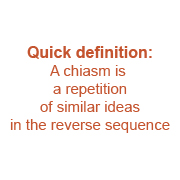
In literature, there are an impressive number of names for this rhetorical device: chiasmus, chiasma, inverse parallelism, inverted parallelism, introversion, symmetric parallelism, palistrophe, formgeschichite, concentric patterns, chiastic structure, chiastic approach, or a chiasm. Simply put, a chiasm is a repetition of similar ideas in the reverse sequence. It is the arrangement of repeated thoughts or phrases that accomplishes the emphasis. Each repeated thought or phrase is called a theme. In a chiasm, there will be two or more themes that, when combined together, are called a structure. Each theme is assigned a level.

First example:

No one can serve two masters.
Either he will hate the one and
love the other, or
he will be devoted to the one and
despise the other.
You cannot serve both God and Money.
(Matt 6:24) NIV

Chiasms are usually arranged in the same top-to-bottom form as they appear in the text:

A  No one can serve two masters.
  B  Either he will hate the one and
    C  love the other, or
    C' he will be devoted to the one and
  B' despise the other.
A' You cannot serve both God and Money

Note how the verses A and A' have similar themes, as do B and B', and C and C'. For the purposes of clarity and rigor, an alternate way of presenting this chiasm is:

Chiasm about Two Masters
Level First presentation Inversion Theme
A - A′ Two masters (Matt 6:24a) God and money (Matt 6:24c) Two masters: God and money
B - B′ Hate the one (Matt 6:24b) Despise the other (Matt 6:24b) Hating one master
C - C′ Love the other (Matt 6:24b) Be devoted to one (Matt 6:24b) Loving the other master

This chart can take a little time to understand how it relates to the original text. Please take a moment to compare this chart with the verses shown above it. The bottom row in this chart is the same as that portion in the middle of the text. Once you grasp this charting method, you should appreciate the chiastic structure better.

When reading this chiasm, the verses under First presentation are to be read from top to bottom, while the verses under Inversion are to be read from bottom to top. This is done so that the pairs on each Level can be placed together, and then a Theme is assigned to each level.

This chiasm illustrates the presence of three themes: two masters (God and money), hating one of the masters and loving the other master. The first theme, which is about the two masters, is called the A-A′ level. The second theme, which is the hatred of one of the masters, is the B-B′ level. As we move towards the center of the structure, we see that the third theme is the love for the other master, and this is the C-C′ level.

Chiasms are paired so that there is an outside theme and additional themes until the last theme is found in the middle. In this chiasm, there are three levels, although there could be as few as two and as many as eight or ten or even higher.

As stated above, the level that appears at the bottom of this list is at the center of the chiasm. This last level is called the center point. Most of the people that have studied the chiastic approach agree that the portion in the center often contains the most important part of the chiasm – it is usually the emphasis of the passage!

The center point, that is the center of the structure, may contain a pair of themes such as A-B-C-C′-B′-A′ or just one theme as in A-B-C-B′-A′. Some theologians attempt to distinguish these, calling A-B-C-C′-B′-A′ an example of chiastic symmetry and A-B-C-B′-A′ an example of concentric symmetry. However that subtlety is blurred with many people, simply calling them all chiasms.

By looking for chiasms and finding the matching pairs, we can often derive a far deeper meaning of the Bible. The question then becomes "WHY?" are these verses structured this way – "Why the emphasis?". A dialog with the Lord might be appropriate at this point: "Lord, I see this chiastic structure. Now please show me why You wanted to emphasize this."

Second example:

Let's look at another chiasm based on Matthew 11:28-30 (NIV):

A  Come to me all you who are weary and burdened,
  B  and I will give you rest. Take my yoke upon you
    X  and learn from me for I am gentle and humble in heart,
  B' and you will find rest for your souls. For my yoke is easy
A' and my burden is light.

In this chiasm, the center point is a single line rather than two; rather than having C and C' verses, a single line labeled X is presented. We see burden mentioned on the A and A' portions, rest and yoke are presented in that order in the B and B' verses. Many who look at these verses are very content to stop here because we all want the Lord's rest, yet there is a deeper meaning by looking at the X level. Here are the verses in chart form:

Chiasm about Gentleness, Humility and Rest
Level First presentation Inversion Theme
A - A′ Weary and burdened people (v11:28a) People with a light burden (v11:30b) Heavy and light burdens
B - B′ The Lord gives his rest and yoke (v11:28b, 29a) We receive his rest and easy yoke (v11:30a) Rest and yoke
X Learn from Jesus for he is gentle and humble (v11:29b) (no inverted verse) Becoming gentle and humble like Jesus

By looking at this chiastic structure, we see that his rest and yoke are a very important part of these verses (B - B'), but they point to a greater richness of understanding. By looking at the C - C' level, we see the gentle and humble nature of Jesus. Again, a dialog with the Lord can point towards the application of the chiasm: "Lord, I want Your rest. Please help me learn Your gentleness and humility." In this way, chiasms can become a guide for personal application of God's Word.

Repetition in an outer to inward direction is the key to recognizing chiasms. There are hundreds and hundreds of chiasms throughout the Bible; the fun is finding and then applying them. As you read through the Bible and discover a chiasm, try to understand why the verses have been paired together in this way. Many Biblical authors such as Joshua, Matthew and John clearly understood the value of this style, while others such as Luke and Paul seemed to use this style less frequently and/or in a more rudimentary pattern. In this way, you will learn a secret that has been hidden in the Bible and is available for all to receive.

Resources:

In my zeal to learn more about chiasms in the Bible, I have read a number of books about this fascinating topic. Recently I compiled a list of what I believe are the more relevant and readable books, placing them in Amazon's Listmania. Some books, such as Dr. David Dorsey's Literary Structure of the Old Testament and Nils Lund's Chiasmus in the New Testament are devoted just to the chiastic structure, while others come at the topic as it relates to other Biblical themes. I hope you will forgive me: I included my book, Joshua's Spiritual Warfare: Understanding the Chiasms of Joshua, in the list because it takes the reader from identification of chiasms to application.

About the author:

Thomas B. Clarke (Tom) is an avid student of the Bible, digging into areas that are often not commonly understood. He is the author of three Christian books including Joshua's Spiritual Warfare: Understanding the Chiasms of Joshua (available as paperback and eBook).

In his study of chiasms, he has revealed a topic that has been largely confined to an academic audience. His attempt in this book is to make chiasms more understandable to a broader range of Christian believers. By applying the chiastic approach to spiritual warfare as seen in the book of Joshua, Tom has taken the study of chiasms from identification to application.

Tom's latest title, which is due to be published in late 2012, is a look at typology within the Bible. The surprising revelations of this typology again attempt to bring a lesser known topic to a broader range of people.

Front cover

Home | Joshua's Spiritual Warfare | How to Find Chiasms | Background of Chiasms |
Book Review | Amazon's Listmania about Chiasms | Author's Profile